

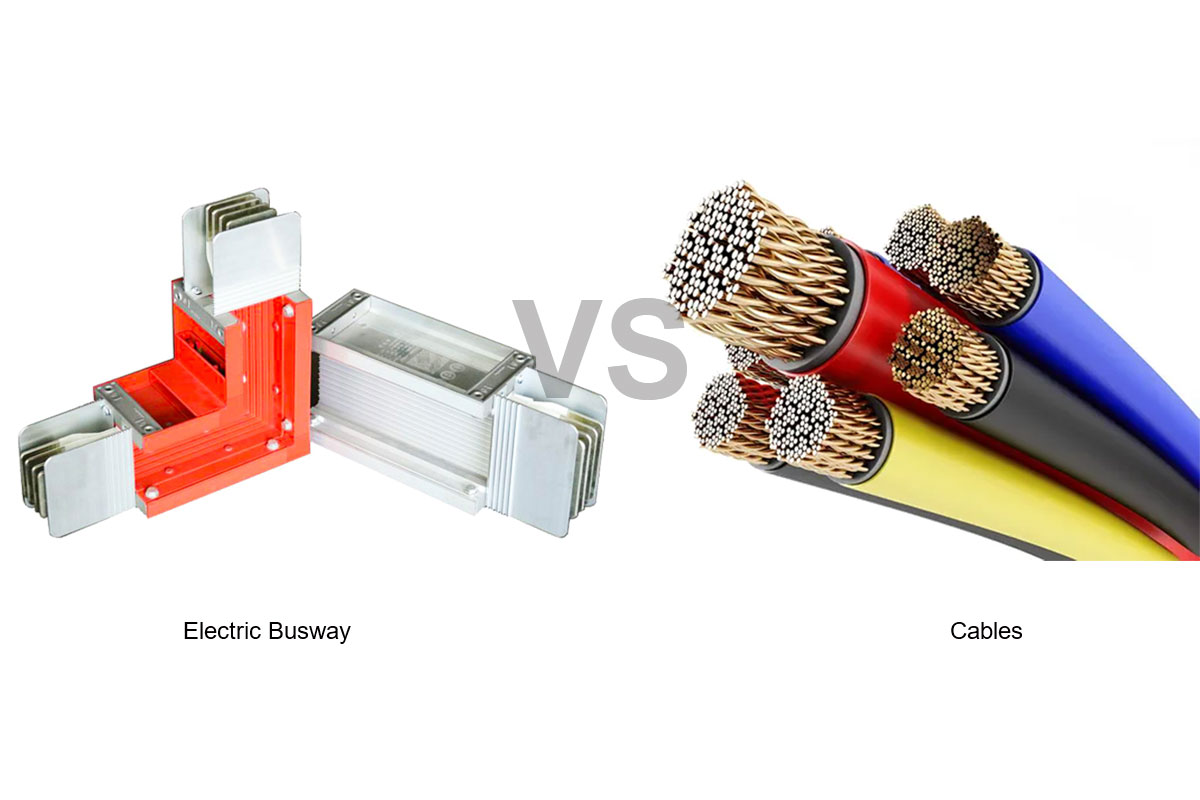
In power distribution system design, the choice between electric busways(or bus ducts) and cables depends on the specific application. For high-current transmission and environments such as high-rise buildings and industrial plants, bus ducts typically exhibit significant advantages.
Here are the core reasons for using bus ducts instead of cables:
1. High Current Carrying Capacity and Space Efficiency
When transmitting high currents (e.g., over 1000A), cables often require multiple cables connected in parallel, which occupies a significant amount of cable tray space and results in complex wiring.
Compact Design: Busways electric have a compact structure, occupying far less space than cable bundles for the same current carrying capacity.
Better Heat Dissipation: The metal casing (usually aluminum or steel) not only serves as a protective shell but also acts as a heat sink, making current transmission more efficient.
2. Flexibility and Scalability
This is one of the most prominent advantages of bus ducts.
Plug-in Hole Design: Bus ducts typically has plug-in holes along its length. If new electrical equipment needs to be added, power can be drawn simply by plugging into a plug-in box, eliminating the need to re-run cables from the distribution cabinet like with cables.
Easy to Retrofit: In factory workshops and other locations where equipment layouts are frequently adjusted, bus ducts can be disassembled and reassembled like Lego bricks.
3. Installation Efficiency and Cost
Although the unit price of bus ducts materials is usually higher than that of cables, the overall cost is often lower:
Installation Speed:Bus ducts is prefabricated in sections, requiring only simple assembly on-site, reducing installation time by more than 50% compared to laying bulky cables.
Savings on Distribution Cabinets: Because power can be drawn directly from the busbar, the number of terminal distribution cabinets can be reduced.
4. Electrical Performance and Safety
Low Voltage Drop:Bus duct has lower impedance, resulting in less voltage drop during high-load operation.
Short-circuit strength: Bus duct is mechanically fixed, making it more resistant to short-circuit electromagnetic forces than cables.
Fire resistance:The outer shell of bus duct is made of non-combustible material, and the chimney effect is weaker. In contrast, the insulation layer of ordinary cables produces a large amount of dense smoke in a fire.
Bus Duct VS Cable Comparison Table
| Features | Bus Duct | Cable |
|---|---|---|
| Space occupancy | Very small, compact structure | Larger, requires cable tray support |
| Installation Difficulty | Modular installation, relatively fast | Laborious laying, high labor costs |
| Branch power supply | Extremely simple (plug box) | Difficult (requires branch junction box or rewiring) |
| Service life | Long-term (30-50 years) | Relatively short, prone to aging |
| Initial investment | Higher | Lower |
If you are working on projects with high current (typically >400A), high-density cabling, or future expansion needs (such as data centers, commercial complexes, and low-voltage power distribution rooms), bus ducts is a more professional and reliable choice.