

1. Definitions and core concepts
what is meant by bus duct?
- A busway (or bus duct) is a closed metal conduit system used in low-voltage power distribution systems to transmit and distribute electrical energy. It is primarily used in high-rise buildings, industrial plants, and commercial complexes to efficiently transmit and distribute the high current generated by transformers or distribution cabinets to various power consumption points. Simply put, a busway (or bus duct) is a type of “electrical highway” used in low-voltage power distribution systems.
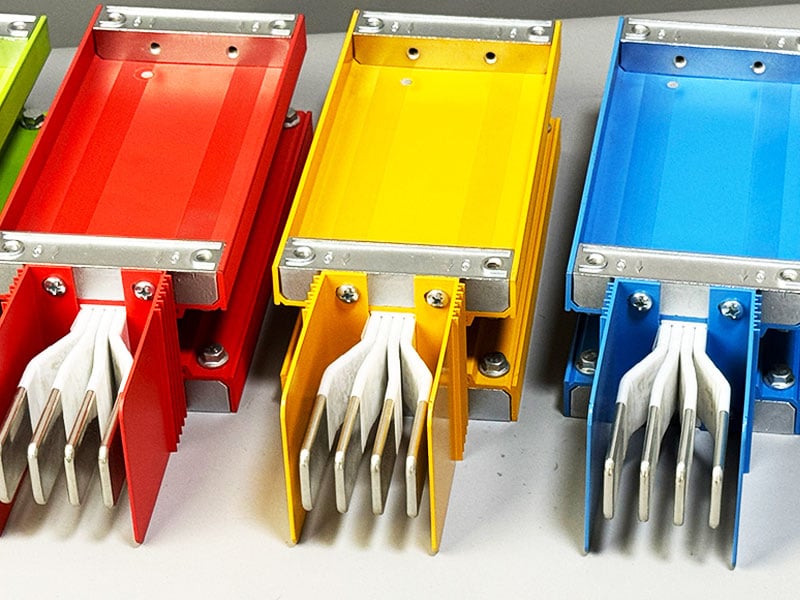
Busway core features
- Structural “closure”:
Unlike the exposed copper busbars in substations, electric busway is fully enclosed. This allows it to operate safely inside densely populated buildings (such as shopping malls and office buildings), preventing electric shock and short circuits caused by foreign objects entering. - Modular layout:
Busway in electrical, like Lego bricks, is composed of standard-length sections (usually 3m or 6m). It connects via connectors and can be fitted with tap-off boxes at any point in the middle as needed. - Functional “high current carrying capacity”:
When transmitting high currents (such as 1000A or more), cables often need to be connected in parallel due to the skin effect and heat dissipation issues, which takes up a lot of space. In contrast, bus duct uses a flat conductor structure, which has higher heat dissipation efficiency, and a single trunking can carry a current of up to 6300A.
Bus Duct vs Cable:
(Click here to learn more about the differences between busways and cables.)
| Features | Bus Duct | Cable |
|---|---|---|
| Very small, compact structure |
Larger, requires cable tray support |
|
| Installation Difficulty | Modular installation, relatively fast | Laborious laying, high labor costs |
| Branch power supply | Extremely simple (plug box) | Difficult (requires branch junction box or rewiring) |
| Service life | Long-term (30-50 years) | Relatively short, prone to aging |
| Initial investment | Higher | Lower |
2. what is a bus duct made for?
A standard bus duct typically consists of the following four core components:
Conductor material - busbar
- High-purity electrolytic copper (T2 copper) or aluminum alloy is typically used. To improve conductivity and corrosion resistance, the copper busbar surface is usually tin-plated or silver-plated. Depending on the current, the number of busbars is usually 4-wire (3P+1N) or 5-wire (3P+1N+PE).
The conductor (copper busbar or aluminum busbar) is the conductive core of the electrical busway, and its processing precision determines its resistivity and temperature rise.
- Straightening and cutting:
The busbar straightening machine is used to straighten the coiled or bundled copper/aluminum busbars and cut them precisely according to the design length. - Punching and bending:
punching holes (for connecting bolts)(busbar punching machine) and bending (making L-shaped and Z-shaped elbows) using a CNC busbar processing machine.(busbar bending machine)
Surface treatment
- Tin plating/silver plating:
Electroplating is performed on the connection end or the entire length to prevent oxidation and reduce contact resistance. - Polishing and cleaning:
Removes oil and oxide film from metal surfaces.
Insulating Medium
- Insulation wrapping:
An automatic wrapping machine is used to evenly wrap polyester film (PET) or mica tape around the conductor. An overlap rate of 50% or higher is typically required. - Heat shrink treatment (optional):
Some busbars use heat shrink tubing, which is dried in a constant temperature oven to make the tubing fit tightly against the conductor. - Testing:
After the wrapping is completed, a single-bar insulation withstand voltage test is performed to ensure there are no breakdown points.
Insulating medium type:
- Thin film insulation:
A polyester film (Class B or Class F insulation) is wound around the conductive busbar. - Air insulation:
using air gaps and insulating support blocks for isolation (Air insulated bus duct). - Integral casting:
The conductive busbar is completely sealed with materials such as epoxy resin (commonly used in places with extremely high requirements for waterproof and fireproof ratings).
Enclosure Fabrication
- The outer casing acts as the “armor” of the bus duct, providing protection and heat dissipation. It is typically made of aluminum-magnesium alloy or steel plate. Aluminum alloy casings are more commonly found in modern mid-to-high-end busways systems because they are non-magnetic, have good heat dissipation, and are highly corrosion-resistant. They can prevent damage from external forces, isolate dust and moisture, and withstand enormous electromotive force stress during short-circuit faults.
- Sheet metal processing:
Using CNC bending machines to process aluminum alloy sheets or galvanized steel sheets into channel shapes. - Coating treatment:
electrostatic spraying (powder coating) is performed to enhance corrosion resistance and provide insulation. - Heat dissipation design:
Modern aluminum alloy housings typically feature heat dissipation fins to increase the heat exchange area.

3. Main types of bus duct
Classification by insulation structure
1. Sandwich bus duct
- It is compact in size (saving building space), has low voltage loss, and high heat dissipation efficiency (heat is directly dissipated through the outer casing).
- It has extremely high short-circuit strength and can withstand huge electrical stress.
2. Air insulated bus duct
- Internal air circulation requires high-precision processing of the conductor surface (anti-oxidation is necessary).
- Temperature rise at the joint is relatively easy to control and maintenance is simple; in high humidity environments, if there is condensation, the air gap can provide a certain buffer.
Classification by protection level and environment
1.Cast Resin Busway
- The conductor is encapsulated and sealed using high-performance insulating resin (such as epoxy resin), and the protection level typically reaches IP68 (the highest level).
- Waterproof, fireproof, corrosion-resistant, and explosion-proof. It can function normally even when submerged in water.
2. Fire-resistant Busway
- The outer shell is coated with fire-retardant paint, and the internal insulation material is made of high-temperature resistant mica tape or ceramic fiber.
- In the event of a fire, it can maintain power supply for 2-3 hours at a high temperature of around 90℃.
Classification by conductor material
- Copper Busway:
It has high conductivity, low voltage drop, strong oxidation resistance, and extremely high reliability. - Aluminum Busway:
Lightweight (about 1/3 the weight of copper), easy to install, and extremely cost-effective.
| Type | Volume | Heat dissipation performance | Protection level | Cost | Cable |
|---|---|---|---|---|---|
| Sandwich bus duct | Minimum | Excellent | IP40-IP65 | middle | Office buildings, shopping malls, factories |
| Air insulated bus duct | Larger | General | IP30-IP40 | Low | Drying room, vertical shaft |
| Cast Resin bus duct | medium | General | IP68 | High | Outdoor, humid, chemical |
| Fire-resistant bus duct | Larger | Poor | IP54 | Higher | Fire protection system |
4. what is the advantage of electrical busway?
Core technological advantages
1. Extremely high current carrying capacity and compact size
- High current carrying capacity:
A single electric busway can handle current ranging from 250A to 6300A. When transmitting high currents, multiple cables need to be connected in parallel, which not only makes construction more difficult but also occupies a lot of space. - Compact design:
Sandwich bus duct significantly reduces the cross-sectional area through its overlapping structure. In space-constrained high-rise building server rooms or data centers, bus duct can save 30%-50% of installation space compared to cable trays.
2. Low impedance and excellent heat dissipation performance
- Small voltage drop:
Due to their large cross-sectional area and compact structure, the copper/aluminum busbars of electric busway have much lower resistance and inductive reactance than cables of the same cross-sectional area, thereby reducing voltage loss in long-distance power transmission. - Heat dissipation from the casing:
The metal casing is in direct contact with or close to the busbar, acting as a huge heat sink. Compared to cables wrapped in insulation and cable trays, it has higher heat dissipation efficiency and more stable operation.
3. Plug-and-Play flexibility
- Reserved interface:
The electric busway is designed with plug-in interfaces at intervals (such as 0.6m or 1m). - No power outage required for capacity expansion:
When adding machines in a factory or adding cabinets in a computer room, power can be drawn simply by mounting the plug-in box on the electric busway, without the need to run cables from the distribution cabinet again as with electrical cables.
4. Stronger short-circuit withstand capability
- Because the conductors are physically isolated and supported by a robust metal casing, the mechanical strength of the electric busway can effectively prevent the busbars from deforming when a short-circuit fault generates enormous electrical stress, making it significantly safer than cables.
what is the benefit of using busways?
1. Reduce long-term TCO
- Long lifespan:
The service life is usually 30-50 years, which is twice that of cables. - High residual value:
Copper/aluminum drains still have extremely high recycling value after the equipment is scrapped (up to 30%-40% of the original price).
2. A qualitative leap in construction efficiency
- Fast installation:
The electric busway uses modular connections, making construction 50%-80% faster than cable laying. This can save significant labor costs in tight project schedules. - Error-proof design:
Constant torque bolts and foolproof connection structure ensure consistent installation quality and reduce the risk of human wiring errors.
3. Enhance the aesthetics and class of buildings
- Electric busway has a clean appearance and strong lines, making it very suitable for commercial spaces with a modern industrial style or open-ceiling design (such as high-end shopping malls and showrooms), eliminating the problems of drooping cables and messy piles.
what is a busway used for?
| Industry Scenarios | Core application value points |
|---|---|
| Data Center | It supports high-density power distribution and is adaptable to frequent expansion and relocation of server racks. |
| Manufacturing | Flexible connectors simplify production line adjustments without requiring large-scale power outages or line rerouting. |
| High-rise Buildings | The use of bus duct in vertical shafts greatly reduces the footprint and improves power supply reliability. |
| Shopping Malls | It facilitates electricity billing and independent switch control for different shops. |
5. How to install bus duct?
How to assemble a busway system?
1. Stacking
- The wrapped conductors (A, B, C, N, PE) are stacked in sequence inside the outer casing.
2. Pressing and riveting
- Technological highlights:
A large-tonnage press is used to squeeze out the internal air, achieving a “dense” structure. - Self-piercing riveting (SPR):
Uses nail-free riveting technology to secure the casing, ensuring structural strength and grounding continuity.
3. Functional unit installation
- Install the starting flange, plug-in interface, and sealing gasket.
Installation Guide
Installation quality directly determines the operational safety of the power system.
1. Site survey and scaffold installation
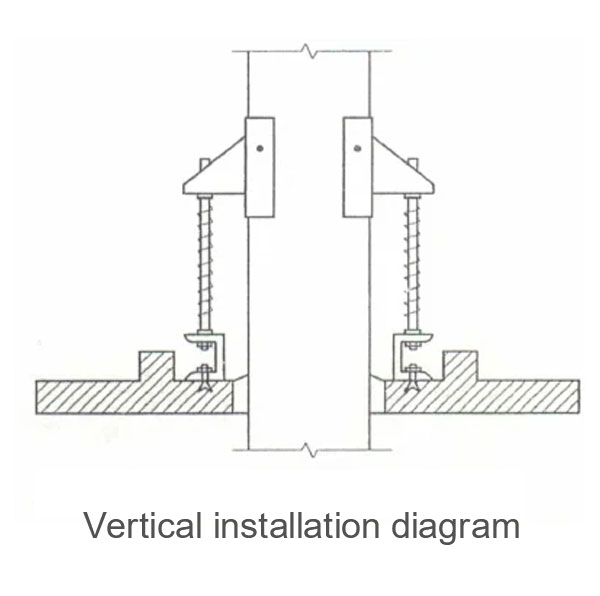
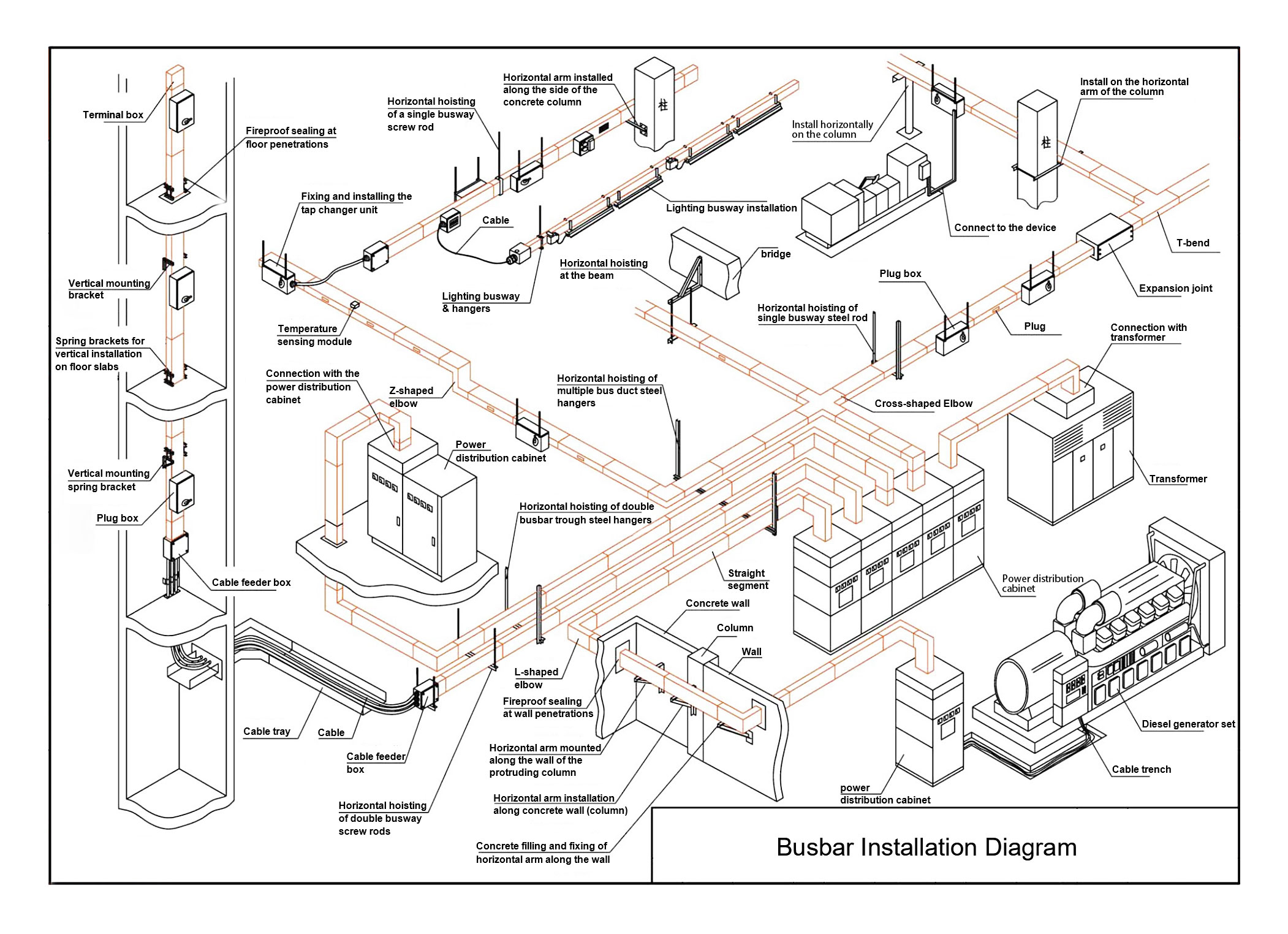
- Support spacing:
When installed horizontally, the support spacing should generally not exceed 2m; when installed vertically, at least one spring support should be installed on each floor. - Alignment and calibration:
Ensure that the brackets are on the same horizontal or vertical line to prevent physical stress from causing the casing to deform after the busbar is assembled.
2. Preliminary insulation performance test (required)
- Before installation, the insulation resistance of each busbar section must be measured using a 1000V megohmmeter.
- Standard:
The insulation resistance of a single section should be ≥20MΩ.
3. Core connection process
- Cleaning the connection surfaces:
Wipe the conductor connection ends with a dry silk cloth, ensuring that there is no moisture or oil. - Torque tightening:
This is the most critical step. Double-ended torque bolts must be used. Tighten until the outer bolt head automatically detaches to ensure the contact pressure meets design requirements (typically 70-80 N·m). - Grounding of the outer casing:
Ensure that the outer casing connection plates of each section of the busbar trunking are firmly installed to form a continuous grounding path.
4. Pre-trial operation checks
- Check that all junction boxes are in the “OFF” state.
- A second overall insulation test was conducted to ensure that the values met the operating standards.
Busway Maintenance Checklist
- Although electric busway is called “maintenance-free” equipment, it is recommended to conduct a comprehensive inspection once a year to prevent major accidents.
| Inspection Items | Maintenance actions | Exception handling |
|---|---|---|
| Temperature rise at connection | Use an infrared thermometer to check the connector temperature. | If the temperature rise exceeds 60K, power must be cut off and bolts tightened. |
| Bolt status | Check if the red indicator pad or marker line has shifted. | If loose, tighten again to the specified torque. |
| Appearance inspection | Check the casing for deformation, rust, or water stains. | Locate the source of the leak or mechanical damage. |
| Plug box inspection | Does the opening and closing mechanism move smoothly? Are there any burn marks on the contacts? | Replace the damaged connector. |
| Dust cleaning | Clean the heat dissipation holes and insulation with dry compressed air. | To prevent dust accumulation from causing creepage. |
Troubleshooting
- Preventing moisture intrusion:
The electrical busway is most vulnerable to water. During the construction period, temporary coverings must be provided to prevent roof leaks or fire sprinkler damage to the insulation. - Overloading is strictly prohibited:
Long-term overloading will cause the insulation material to age rapidly. - Vibration compensation:
When connecting transformers or passing through building expansion joints, flexible links or expansion joints must be installed to absorb vibrations.
6. How to Choose Busways?
- Choosing a bus duct is not just about price. A scientific power distribution solution needs to balance current carrying capacity, environmental adaptability, safety, and total life cycle cost.
- For precision manufacturing, hospitals, and data centers, copper busbars are recommended; for conventional factories and commercial office buildings where budget is a concern, high-quality aluminum alloy busbars are a mature alternative.
1. Conductor material: Copper (Cu) vs. Aluminum (Al)
| Dimension | Copper Busway | Aluminum Busway |
|---|---|---|
| Conductivity | Extremely high(100% IACS | higher(about 61% IACS) |
| Voltage Drop | Small, suitable for long-distance high-current transmission | The size is relatively large, requiring compensation by increasing the cross-sectional area. |
| Weight | It is heavy and has requirements for the building's load-bearing capacity. | Lightweight (weighs only half that of copper for the same current carrying capacity) |
| Antioxidant properties | Excellent, stable connector | It is prone to forming an aluminum oxide film, so copper-aluminum composite technology is required. |
| Comprehensive cost | High (large initial investment) | Extremely cost-effective (saving 30%-50% in costs) |
2. Environmental protection IP Rating
| Installation Environment | IP Rating | Recommended type |
|---|---|---|
| Indoor drying room | IP40 - IP42 | Standard Sandwich Busways |
| Basement/Damp Environment | IP54 - IP65 | Enhanced Sandwich Busways / Waterproof Busways |
| Outdoor/Open-air/Dock | IP68 | Cast Resin Busways |
| Areas requiring sprinkler fire suppression | IP66 | High-grade Sandwich Busways |
3. Insulation structure: Sandwich type is the mainstream
- Preferred choice:
Sandwich bus duct. Its conductors are tightly stacked, which not only makes it small in size, but also eliminates the “chimney effect” (preventing fire from spreading upwards along the cavity during a fire), resulting in low impedance and rapid heat dissipation. - Special requirements:
Fire-resistant bus duct. If the line is used for fire elevators, emergency lighting, or smoke control systems, it must have a fire resistance time certified by a national testing agency (e.g., 90-180 minutes).
4. Calibration of key technical parameters
- Rated Current:
The selected model should meet the requirement that In ≥ 1.25 × calculated current. - Temperature rise limit:
For high-quality bus duct, the temperature rise at the joints should be controlled within 60-70K under rated current. Excessive temperature rise will accelerate insulation aging. - Short circuit withstand capability (Icw):
Ensure that the bus duct can withstand the maximum short-circuit current surge that may occur on the transformer side.
5. Ease of use and scalability
- Plug density:
Based on the equipment distribution, determine the number of plug holes reserved for each bus section. - Plug-in box compatibility:
Does it support hot-swapping? Are internal circuit breaker brands selectable? - Expansion compensation:
If the straight length exceeds 60m or crosses a building expansion joint, expansion joints must be installed; otherwise, physical displacement will crack the outer shell or damage the joint.
Checklist
| Inspection Category | Inspection content |
|---|---|
| Check for torque-controlled bolts | Ensure even pressure during installation; workers do not need to tighten by feel. |
| Confirm the casing material | Because aluminum alloy casings are non-magnetic, they do not generate eddy current heating under high frequency and high current, making them superior to steel casings. |
| View type test report | Ensure that the manufacturer provides a third-party testing report that complies with IEC or GB standards. |
| Considering residual value | Copper busbars still have extremely high recycling value even after 30 years of obsolescence, which is a plus in long-term asset valuation. |